
 Available in US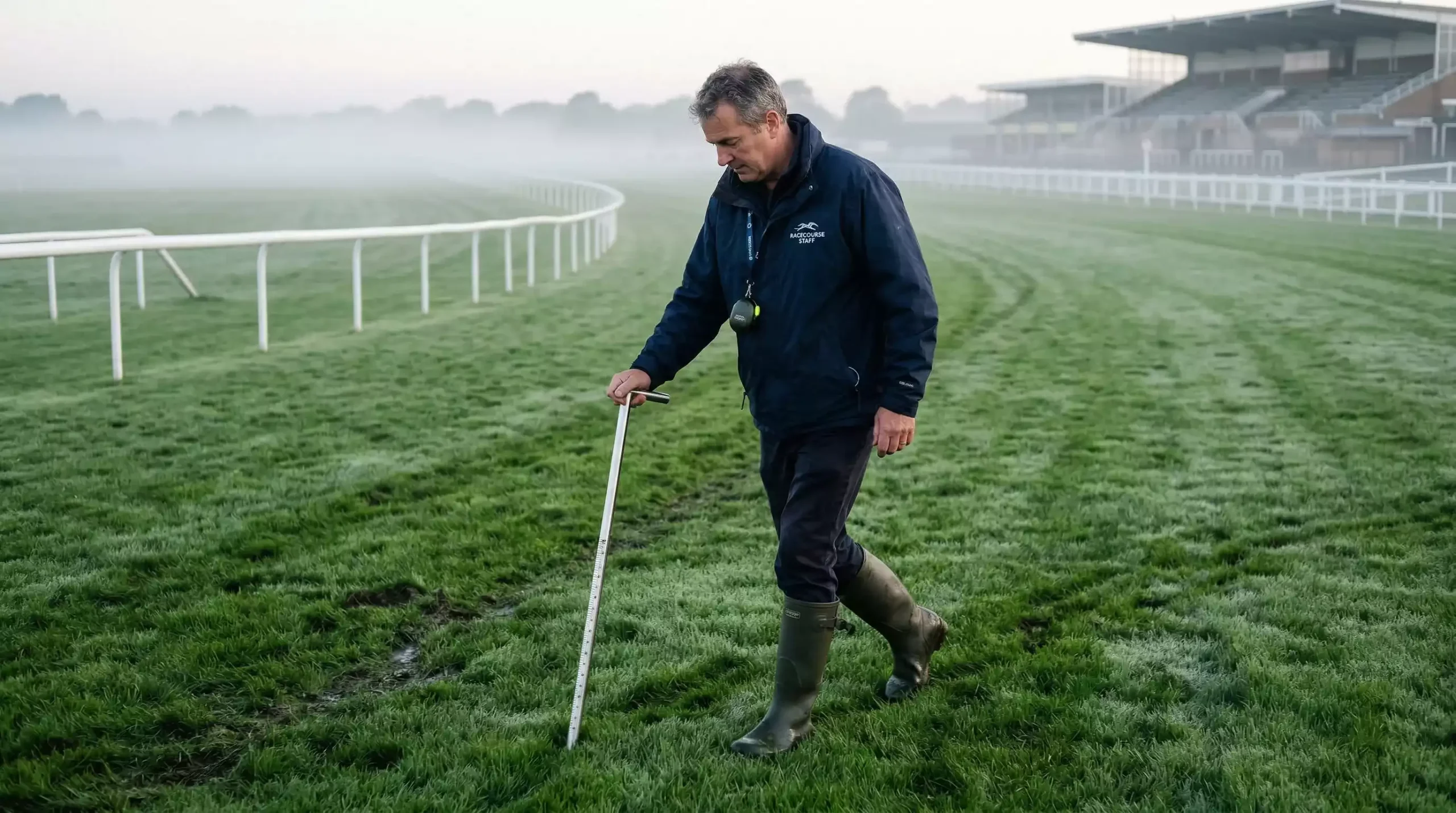
The going report describes the ground a horse will race on, and for tomorrow’s card it can change right up until morning inspections. A report issued at 4pm might read “good to firm.” By 8am, after overnight rain, it could be “good to soft” — and with that shift, two or three horses in a twelve-runner field may no longer be suited to the conditions. Understanding the going scale, the tools used to measure it, and the direct link between ground changes and non-runners gives you a practical edge that most casual punters do not bother to develop. Going Report Tomorrow — More on this topic at non runners tomorrow.
The going decides which horses stay — and which go. This article covers the full UK going scale, explains how the going stick works, and shows why changes in ground conditions are the single largest trigger for withdrawals in British racing.
The UK Going Scale — From Heavy to Firm
British racing uses a descriptive scale to classify ground conditions, running from the softest to the firmest. On turf, the official descriptions are: heavy, soft, good to soft, good, good to firm, and firm. All-weather surfaces use a separate scale — standard, slow, and fast — because synthetic tracks behave differently from natural turf and are far less affected by rainfall.
Each description corresponds to a range on the going stick (more on that below), but the labels carry meaning beyond the numbers. “Good” is considered the benchmark — ground that is neither too soft nor too firm, suitable for the widest range of horses. Move toward heavy and the ground becomes energy-sapping, favouring horses with stamina and a low, grinding action. Move toward firm and the surface becomes faster but harder on joints, favouring horses with a quick, clean stride that handles the impact.
The going can vary across different parts of the same course. A clerk of the course will sometimes report “good to soft, soft in places,” meaning certain sections — typically the lower-lying bends or areas that drain poorly — are softer than the headline description suggests. These localised variations matter. A horse drawn on the inside rail at a track where the rail runs along the softest strip faces different conditions from a horse drawn wide on better ground, even though the official report is the same for both.
Importantly, the going can also change between races on the same card. Persistent rain during an afternoon meeting will soften the ground progressively, meaning the going for the first race at 2pm may genuinely differ from the going for the last race at 5pm. Clerks update the description between races when they judge the change is significant enough to warrant it. For punters, that means a going report checked the evening before is a starting point, not a guarantee.
How the Going Stick Measures Ground Conditions
The going stick is a handheld electronic device that measures the penetration and shear resistance of turf. A clerk of the course pushes the stick into the ground at multiple points around the track, and the device produces a numerical reading. Low numbers indicate soft, waterlogged ground; higher numbers indicate firmer conditions. The scale runs roughly from 1.0 (heavy) through to 13.0 or above (firm), with “good” sitting around 7.0 to 8.5 depending on the time of year and the specific course.
Before the going stick was introduced in the mid-2000s, clerks relied entirely on subjective judgement — walking the course, pressing a heel into the turf, and making a call. The stick brought a degree of objectivity, though interpretation still matters. Two courses can produce the same going stick reading but ride differently because of underlying soil type, drainage infrastructure, and how recently the track was used. The number provides a baseline; experience fills in the rest.
For punters, the going stick reading is published alongside the verbal going description on the Racing Post, Timeform and BHA platforms. Watching the number trend — say, from 7.2 at lunchtime to 5.8 by the evening after rain — gives a more precise picture of how the ground is moving than the verbal description alone, which may not be updated until the change crosses a threshold between categories.
Why Changes in Going Trigger Non-Runners
Ground conditions are the single biggest cause of withdrawals in British racing. According to BHA data, the going accounts for approximately 35 per cent of all non-runners — a proportion that has been consistent over many years of monitoring. When the going changes between declaration and raceday, trainers face a straightforward choice: run the horse on unsuitable ground, or scratch and wait for the right conditions.
Most choose to scratch, and for good reason. Running a horse on ground it dislikes risks poor performance, which damages its handicap rating, and worse, risks injury. A flat-action horse pounding over heavy ground puts additional stress on tendons and joints. A big-striding jumper on firm ground jars its legs on every landing. The cost of a single unsuitable run can be weeks of lost training time, which is why trainers — especially those with large strings and long-term targets — are quick to pull when the ground shifts.
The scale of the problem becomes vivid in extreme weather periods. The BHA’s November 2024 Racing Report noted that in January and February 2024, 78 per cent of Jump fixtures were staged on soft or heavy ground — compared with a three-year average of just 48 per cent. That saturation drove non-runner rates sharply upward and shrank average field sizes, because a meaningful portion of the trained horse population simply could not handle the conditions. Festivals and feature races were not exempt; even high-profile meetings saw fields thinner than planned.
For the punter, the connection between going changes and non-runners is the single most actionable piece of knowledge in this space. If you can read a weather forecast and match it to your selections’ ground preferences, you can anticipate withdrawals before they happen — and in some cases, find value on horses whose chances improve as rivals drop out.
How to Read a Going Report Before Tomorrow’s Racing
A going report typically includes three elements: the verbal description, the going stick reading, and any additional clerk’s notes about watering, rail positions or localised variations. All three matter.
Start with the verbal description to establish the broad category. Then check the going stick reading to see where within that category the ground sits — “good to soft” with a reading of 6.8 is closer to good than “good to soft” with a reading of 5.2, which is edging toward soft. Finally, read the clerk’s notes. If the report says “watered on the straight course” at a summer Flat meeting, the going in the straight may ride differently from the round course, which affects which races are most likely to produce non-runners. See also How Weather Affects Horse Racing.
The key habit is to check the report twice: once when it is issued (usually late afternoon the day before), and again in the morning after overnight weather has had its effect. That second check is where the actionable changes appear. A report that read “good to firm” at 5pm may have shifted to “good, good to soft in places” by 8am if rain arrived overnight. That shift alone can trigger one or two withdrawals in a ten-runner field, and the market will not fully reprice until those non-runners are officially confirmed.
