
 Available in US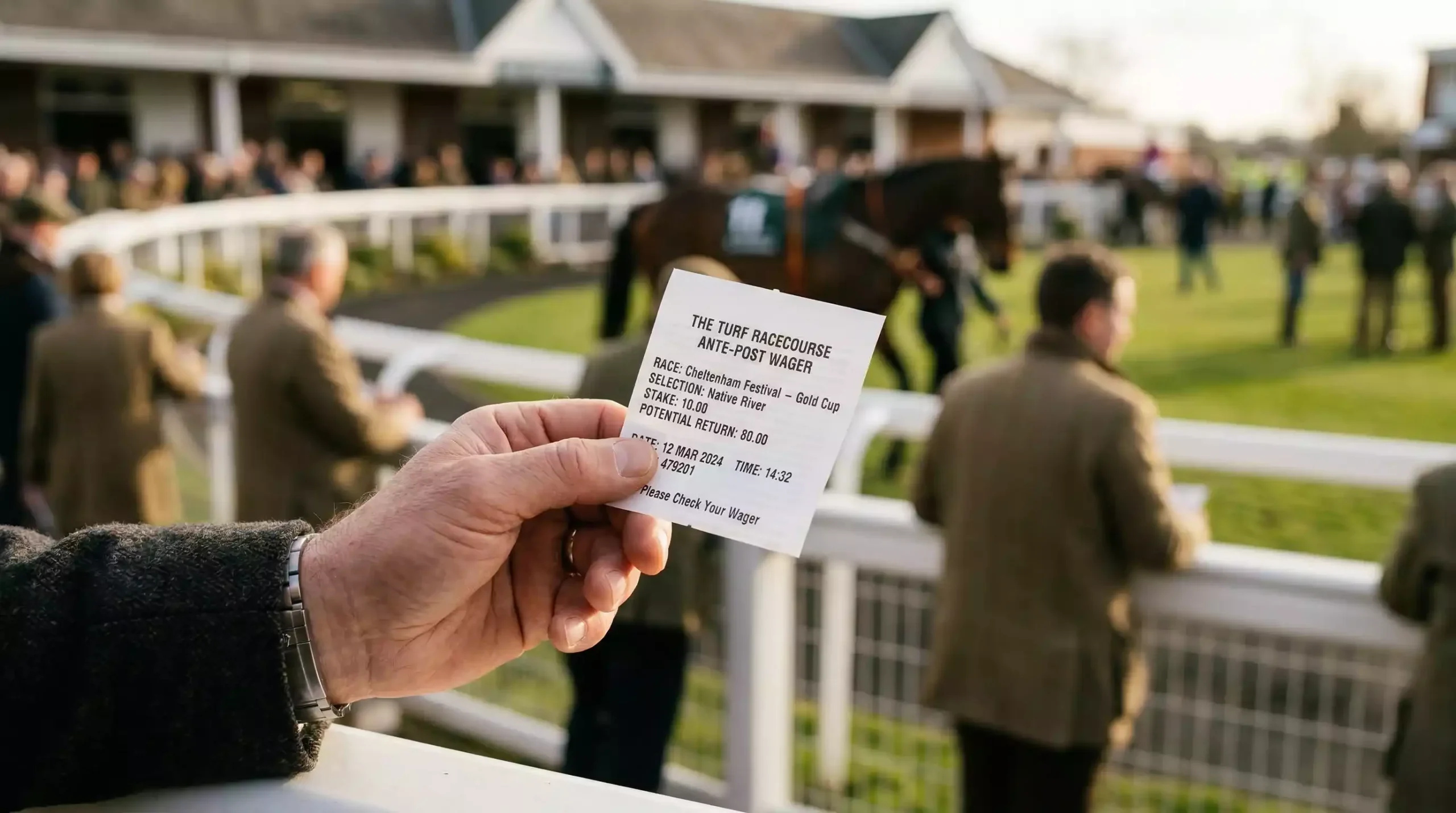
Ante-post bets offer better odds in exchange for accepting the risk that your horse may not run. That trade-off is the defining feature of the market — you get a price the day-of-race bettor will never see, but if your selection is withdrawn, your stake is typically gone. No refund, no void, no adjustment. The bookmaker keeps your money. Ante-Post Betting Rules — More on this topic at non runners tomorrow.
Ante-post odds come with ante-post risk. This guide explains the default rule, the exceptions where you do get protection, and practical strategies for managing the risk of backing a horse that might never make it to the start.
The Default Rule — Stake Lost on NR
The standard across all licensed UK bookmakers is clear: if you place an ante-post bet and the horse does not run, your stake is lost. This applies whether the horse is withdrawn because of injury, going conditions, a trainer’s tactical decision, or any other reason. The logic from the bookmaker’s side is that ante-post prices are longer precisely because they reflect the additional uncertainty. You are being compensated for the risk of a non-runner through better odds — and if that risk materialises, the bookmaker is not obliged to refund.
The financial scale of the risk is not hypothetical. At the 2024 Cheltenham Festival, trainer Nicky Henderson was forced to withdraw seven horses due to illness sweeping through his yard, including high-profile entries such as Constitution Hill and Shishkin. The estimated prize money lost from those withdrawals was roughly 1.3 million pounds. For punters who had backed those horses ante-post at generous prices weeks or months earlier, the stake was simply gone — no matter how confident the selection had looked at the time of the bet.
This is the default that every ante-post bettor must accept. The price you see today on a Cheltenham favourite or a Grand National hopeful is not a free lunch. It is the market’s assessment of value plus the embedded risk of the horse never running. If you cannot afford to lose the stake entirely, ante-post betting may not suit your approach.
When You Do Get Protection — NRNB on Ante-Post
The exception to the default rule is non-runner no bet (NRNB), a promotional offer that some bookmakers apply to selected ante-post markets. Under NRNB terms, if your horse does not run, your stake is refunded — effectively removing the non-runner risk from the ante-post wager.
NRNB is most commonly offered on high-profile festival races, particularly the Cheltenham Festival, the Grand National, and Royal Ascot. The Cheltenham Festival’s 2025 edition carried a total prize fund of 4.93 million pounds, which underlines why bookmakers are willing to absorb the cost of NRNB promotions — the volume of ante-post betting on these markets is enormous, and the promotion drives customer acquisition and retention.
Not every bookmaker offers NRNB on the same races, and the terms vary. Some apply NRNB from the moment the market opens; others activate it only within a certain window, say 48 hours before the race. Some extend NRNB to each-way ante-post bets; others limit it to win-only stakes. Reading the specific terms before placing the bet is essential. A punter who assumes NRNB covers their ante-post each-way double, only to discover it applies to singles on win markets only, is in for an unpleasant surprise.
Strategies for Managing Ante-Post NR Risk
The simplest strategy is to use NRNB markets wherever they are available. If two bookmakers offer the same horse at similar prices but one includes NRNB and the other does not, the choice is obvious. You are trading a marginal price difference for complete protection against the most frustrating outcome in ante-post betting.
When NRNB is not available, stake sizing becomes the primary defence. The conventional approach is to limit ante-post stakes to amounts you can afford to lose entirely, treating the bet as high-risk by design. A common rule of thumb among experienced festival punters is to stake no more than half of what you would place on a day-of-race bet on the same horse. The logic is that the better price compensates for the lower stake — if the horse runs and wins, the return is broadly similar, but if it does not run, the loss is smaller.
Diversification is another lever. Rather than placing a single large ante-post bet on one horse, some punters spread their festival exposure across several selections in different races. If one is withdrawn, the others remain live. This does not eliminate risk — it is possible for multiple withdrawals to hit in the same festival — but it reduces the variance compared with concentrating everything on one outcome.
Timing matters too. Ante-post prices are generally longest furthest from the race, which means the best value often comes with the highest risk of withdrawal. As the race approaches and the horse survives each declaration stage, the odds shorten but the risk decreases. Some punters split the difference by placing a smaller ante-post wager early for the bigger price and then backing the same horse again closer to raceday if it is confirmed, using the second bet to guarantee exposure regardless of what happens to the first.
Finally, monitor the yard. Trainers who publish regular updates on their horses’ wellbeing — through stable tours, press interviews or social media — give you more information to work with than those who stay silent until the morning of declarations. If a trainer’s yard has been hit by a virus, or if a horse has missed a key piece of work, those signals reduce the appeal of an ante-post bet regardless of the price. Ante-post betting is not just about the odds; it is about the probability that the horse will make it to the racecourse at all.
Real Ante-Post NR Scenarios — Lessons from 2024
The Henderson yard crisis at Cheltenham 2024 is the most vivid recent example. Seven horses withdrawn from a single stable, including two of the highest-profile entries at the festival. Punters who had backed Constitution Hill for the Champion Hurdle at 6/4 months earlier lost their stakes when the horse was pulled due to illness. Those who had used a bookmaker offering NRNB received their money back. The gap between the two experiences was defined entirely by whether the punter read the terms before placing the bet.
Beyond the Henderson case, ante-post non-runners are routine at every major festival. Horses that are aimed at a particular race in December may not make it to March. Setbacks in training, minor injuries that require rest, or a change in the going forecast can all produce withdrawals in the final weeks before the meeting. The Cheltenham Gold Cup regularly sees one or two ante-post market principals withdrawn in the days leading up to the race — it is a feature of the market, not an anomaly. See also How Rule 4 Affects Your Accumulator.
The lesson across all of these scenarios is consistent: ante-post betting rewards patience and discipline. Back at the best price, protect where you can with NRNB, size your stakes to reflect the real risk of withdrawal, and accept that some bets will be lost before the horses even reach the course. The punters who thrive in this space are those who treat non-runners as a built-in cost, not an unexpected disaster.
