
 Available in US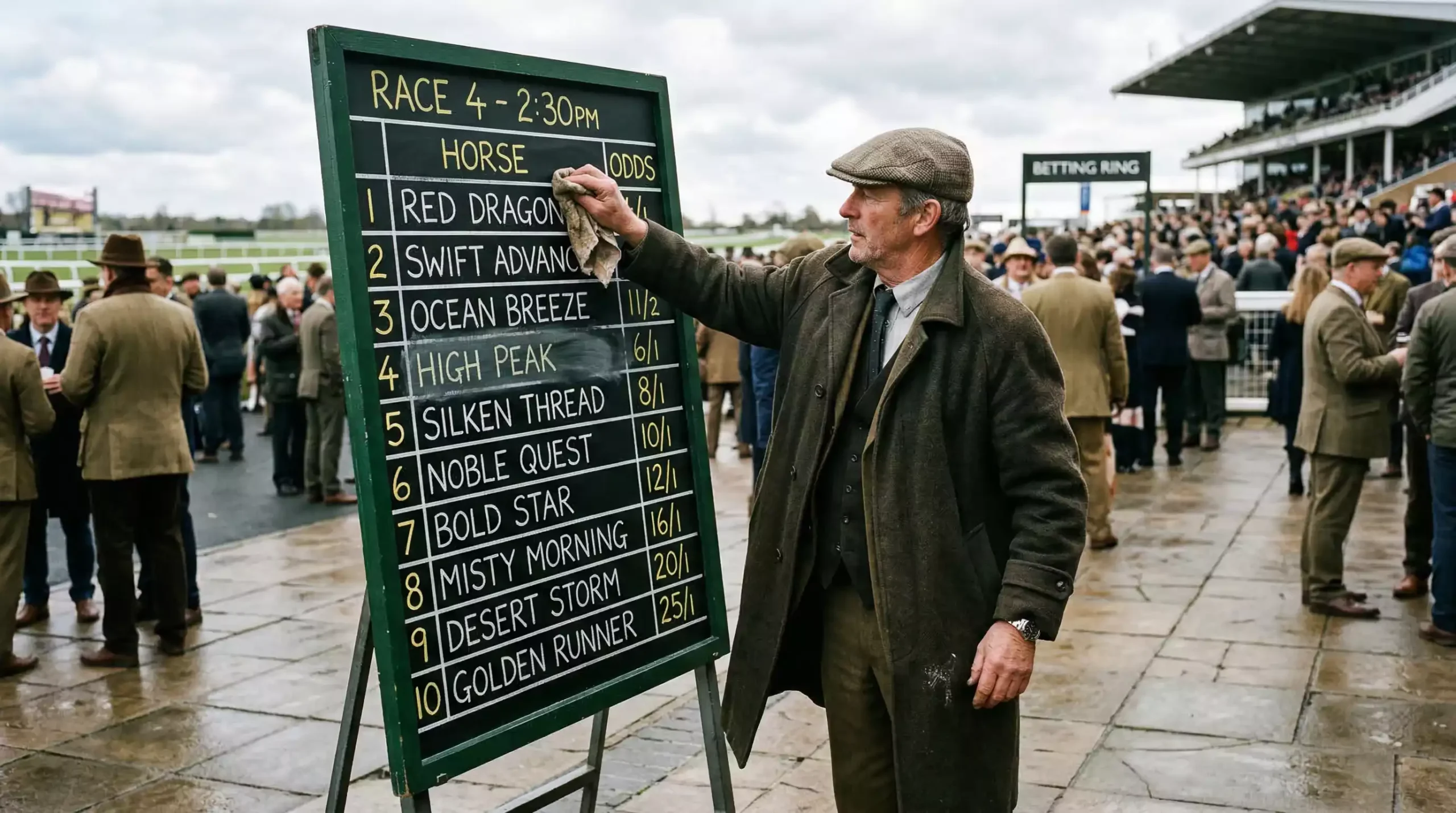
Late non-runners hit the betting market hardest. By the time a horse is pulled after the final overnight declarations, prices have already been set, bets have already been placed, and the market is built around a field that no longer exists. A favourite scratched two hours before the off sends a ripple through the entire race — odds shift, Rule 4 deductions activate, accumulators are adjusted, and punters who placed their bets the night before discover the landscape has changed without warning. Late Non Runners — More on this topic at non runners tomorrow.
The later the scratch, the bigger the ripple. This article explains when late non-runners happen, how they move the market, what you can do when one affects your bet, and the penalties the BHA imposes on trainers who withdraw horses at short notice without sufficient cause.
When Late NR Happen — From Morning Exercise to Paddock
The term “late non-runner” has no single official definition, but in practice it refers to any horse withdrawn after the final declaration stage — that is, after the confirmed runners list has been published. For Flat racing, the declarations close approximately 48 hours before the race; for Jump racing, 24 hours before. Any withdrawal after those deadlines creates a late non-runner.
Most late withdrawals happen in the morning of raceday, between roughly 6am and 10am. This is when trainers watch their horses work at morning exercise, assess any overnight changes in the horse’s condition, and check the latest going report. A horse that looked fine at evening stables might show a slight stiffness at morning exercise that the trainer decides is not worth risking. Or the going report, updated at dawn, might show ground that has moved a full category from the previous day’s description.
A smaller number of late non-runners emerge even closer to post time — during the pre-race veterinary inspection, in the saddling area, or in the paddock. These are the most disruptive because they give the market almost no time to adjust. The BHA has been working to reduce delays associated with late withdrawals; by Q1 2025, 87.6 per cent of races were starting within two minutes of the scheduled off time, up from 79.2 per cent in 2024 and 72.7 per cent in 2023. That improvement reflects tighter management of the pre-race window, but late non-runners remain one of the factors that can push a race beyond its scheduled start.
Withdrawals at the very start — a horse refusing to load into the stalls, for instance — are now handled under Rule (H)6, which allows stewards to declare the horse a non-runner rather than letting it be classified as a runner that never competed. That rule, introduced in May 2024 for stalls races and extended to Jump starts in October 2025, has been used roughly half a dozen times in its first year.
How Late Withdrawals Move the Market
When a horse is withdrawn late, the betting market cannot reprice naturally through normal trading because there is not enough time. A horse that was 3/1 second favourite is pulled at 10am; by 10:05am, the bookmakers have adjusted their boards, but the thousands of bets already placed at the old prices still stand. Rule 4 bridges the gap.
The Rule 4 scale applies a fixed deduction to winning bets based on the starting price of the withdrawn horse. The scale runs from 90p in the pound for very short-priced withdrawals down to 5p in the pound at 10/1 to 14/1. If the withdrawn horse was 14/1 or longer, no deduction applies. The deduction is taken from the profit portion of your winning bet — you get your stake back in full, but the winnings are reduced.
The market impact goes beyond Rule 4. When a fancied horse is withdrawn late, the remaining horses’ implied probabilities shift. A 3/1 second favourite leaving the race redistributes roughly 25 per cent of the win probability across the rest of the field. The horse that was 5/1 might suddenly be a more realistic 7/2; the outsider at 20/1 might drift slightly or hold firm depending on whether its chance was related to the withdrawn horse. For exchange users on Betfair, the prices adjust in real time through trading, but the reduction factor — calculated from the withdrawn horse’s traded price — applies to all bets matched before the withdrawal.
In accumulators, a late non-runner in one race voids that leg and drops the bet down by one fold. But if the same late withdrawal triggers a Rule 4 deduction in a race where another leg of your accumulator sits, the deduction applies on top of the void. The compounding effect is why late non-runners in competitive races can make a noticeable dent in an afternoon’s returns.
What to Do When a Late NR Affects Your Bet
If your selection is the late non-runner, the answer is straightforward: your single bet is void and your stake returns. In an accumulator, the NR leg is voided and the bet steps down. There is nothing to do except accept the reduced structure.
The more interesting question is what to do when a late non-runner is not your selection but a horse in one of your races. The withdrawal might actually improve your horse’s chance — removing a rival from the field is never bad news for the remaining runners — but Rule 4 will reduce your payout if you win. In that situation, you have to weigh whether the improved winning probability outweighs the deduction. Often it does, particularly when the withdrawn horse was a main rival to your selection rather than a no-hoper at the back of the market.
For punters who spot a late non-runner before the bookmaker adjusts, there can be a brief window of value. If the second favourite is withdrawn and a bookmaker has not yet shortened the favourite, the current price on the favourite is temporarily generous. That window is narrow — minutes, sometimes less — but it exists, and it is one of the reasons experienced punters monitor non-runner feeds in real time on raceday mornings.
BHA Penalties for Avoidable Late Withdrawals
The BHA distinguishes between legitimate late withdrawals and avoidable ones. A horse found lame at morning exercise or a vet failing a horse at the pre-race inspection are legitimate — the trainer had no way to know earlier. A trainer who simply changed their mind about running, or who decided overnight that a different engagement was preferable, faces scrutiny.
Trainers who withdraw horses after 9am on raceday using a self-certificate are subject to increased penalties. The BHA can impose fines, and repeat offenders accumulate non-runner rate points that count toward the quarterly threshold — 12 per cent on the Flat, 9 per cent over jumps. Exceeding the threshold means losing the right to self-certify withdrawals for 12 months, which forces the trainer to obtain a vet certificate for every subsequent non-runner. That administrative burden acts as a meaningful deterrent against casual late scratches. See also Self-Certificates & Vet Certificates.
The system is designed to protect the integrity of the declared field. Punters place bets based on published runners; bookmakers price markets based on the same list. A late withdrawal undermines both, and the BHA’s penalty framework reflects the view that unnecessary late non-runners are a cost imposed on everyone else in the sport — from the bettor whose accumulator is restructured to the jockey who loses a ride to the rival trainer whose horse now faces different competition. The penalties are proportionate rather than draconian, but they are real, and they are enforced.
