
 Available in US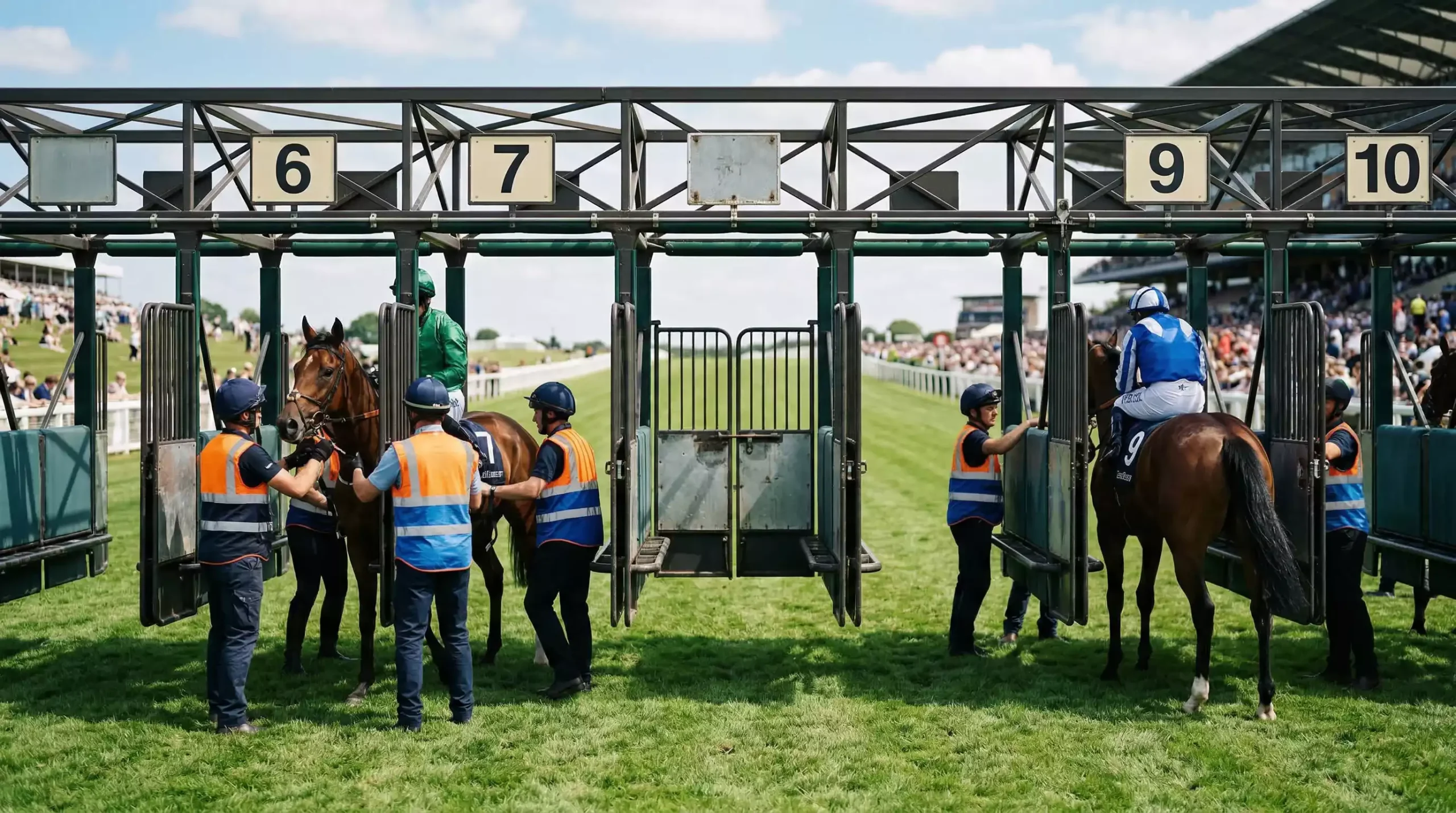
When a horse is withdrawn from a flat race, the stall it was assigned does not simply stay empty. The remaining runners are reshuffled — a process sometimes called defragging — so that the occupied stalls form a continuous block with no gaps. That sounds like a minor administrative detail, but for anyone who analyses draw bias, it changes everything. The horse you assessed as “drawn in stall 8” might now effectively be racing from stall 6, and the draw bias data you relied on no longer maps cleanly onto the revised starting positions. Stall Shuffling After Non Runners — More on this topic at non runners tomorrow.
An empty stall does not stay empty. This article explains how stall defragging works at UK courses, why it matters for draw bias analysis, and how to adjust your assessment after non-runners reshape the starting grid.
How Stall Defragging Works at UK Courses
The principle is straightforward. When a non-runner is confirmed, the stall handler at the racecourse removes the gap by sliding the remaining runners into a contiguous block. If twelve stalls were loaded and stall 5 is now empty because of a non-runner, the horses in stalls 6 through 12 each move one position inward, so the eleven remaining runners occupy stalls 1 through 11. The original stall numbers printed on the race card are replaced by the effective stall positions at the start.
As FlatStats explains in its analysis of adjusted draw biases, this defragging process means that the draw a horse was originally allocated is not necessarily the draw from which it starts the race. The distinction matters because draw bias statistics are calculated on actual starting positions, not allocated stalls. If draw data shows that stall 1 has a 40 per cent win rate at a particular course, that refers to the horse that physically broke from the innermost stall — which might have been originally drawn in stall 2 or stall 3 if lower-drawn horses were withdrawn and the field was defragged.
The mechanics are not always identical across every course and every starter’s team. Some courses defrag toward the inside rail by default; others may adjust based on where the non-runner was drawn. The general tendency in British racing is to close gaps from the high side — meaning a non-runner drawn low causes high-drawn horses to shift down — but the specifics can depend on the course’s standing instructions and the starter’s discretion on the day.
For punters, the practical implication is that you cannot simply read the allocated draw from the race card and apply raw draw bias statistics. After non-runners, you need to work out the adjusted draw — the stall position the horse will actually occupy at the break — and then apply the bias data to that revised position. Missing this step is one of the most common errors in draw-based analysis, and it compounds in races with multiple non-runners where the shifts are larger.
The Impact on Draw Bias Statistics
Draw bias is one of the most powerful edges available to flat racing analysts, but it is only accurate when applied to the correct starting position. At Chester, where the tight left-handed turns give a massive advantage to low-drawn horses, the numbers are stark: 61.7 per cent of all flat races since 2010 have been won by horses starting from stalls 1 to 4. Among non-runners at Chester, 54.6 per cent were high-drawn horses — a pattern consistent with trainers withdrawing horses that drew wide at a course where a high draw is a near-insurmountable disadvantage.
Now imagine a 10-runner race at Chester where two high-drawn horses are withdrawn. The defragging process shifts everyone down, and the horse originally in stall 7 is now starting from stall 5. The pre-non-runner draw analysis that flagged stall 7 as poor no longer applies — the horse is now in a much stronger effective position. If your draw bias model does not account for this shift, it is feeding you stale data.
The effect runs in both directions. At a course like Beverley, where the bias favours high draws in certain races, the pattern reverses: 54.8 per cent of non-runners are drawn low, and the remaining runners shift upward. A horse that was originally in stall 4 and assessed as having a reasonable draw might now be in effective stall 3, which could be worse or better depending on the specific race distance and configuration.
How to Adjust Your Draw Analysis After Non-Runners
The adjustment process is manual but not complicated. Start with the declared runners and their allocated stalls. Remove the non-runners. Renumber the remaining runners sequentially from 1 to N, where N is the number of remaining runners. This gives you the adjusted draw — the positions that will actually be loaded at the start.
Next, apply draw bias statistics to the adjusted positions, not the original ones. If your data shows stalls 1 to 3 winning 55 per cent of races at this distance on this course, check which horses now sit in adjusted stalls 1 to 3. One of them might be a horse you had dismissed because its original draw looked poor — and after defragging, it is suddenly in the most favourable zone.
The reverse is equally important. A horse that was drawn in stall 2 and appeared to hold the best draw might shift to adjusted stall 1 after a lower-drawn non-runner, which at some courses is marginally less favourable than stall 2 due to proximity to the rail. These are fine margins, but draw bias operates on fine margins — a few percentage points in win rate can be the difference between a value bet and a losing proposition.
The best approach is to build this adjustment into your routine. Whenever you see a non-runner confirmed in a flat race, immediately recalculate the adjusted draws for the remaining field. Over time it becomes automatic, and you start to spot the situations where a withdrawal has improved or damaged a specific horse’s prospects before the market has priced it in.
Tools That Account for Stall Changes
FlatStats is the primary UK resource for adjusted draw bias data. Its database records actual starting positions rather than allocated stalls, which means the draw statistics it publishes already reflect historical defragging. When you look up draw bias at Chester or Beverley on FlatStats, you are seeing the real performance of horses that broke from each physical stall position, accounting for all the non-runner shuffles that happened over the years. See also Pace Analysis When Horses Withdraw.
Timeform and Racing Post publish allocated draws on the race card but do not automatically adjust for non-runners. The adjustment is left to the punter. Some third-party tools and spreadsheets have been built by the form analysis community to automate the recalculation — input the declared field and stalls, mark the non-runners, and the tool spits out the adjusted draw. These are niche resources, but for anyone who treats draw bias as a core part of their approach, they save time and reduce errors on busy raceday mornings.
