
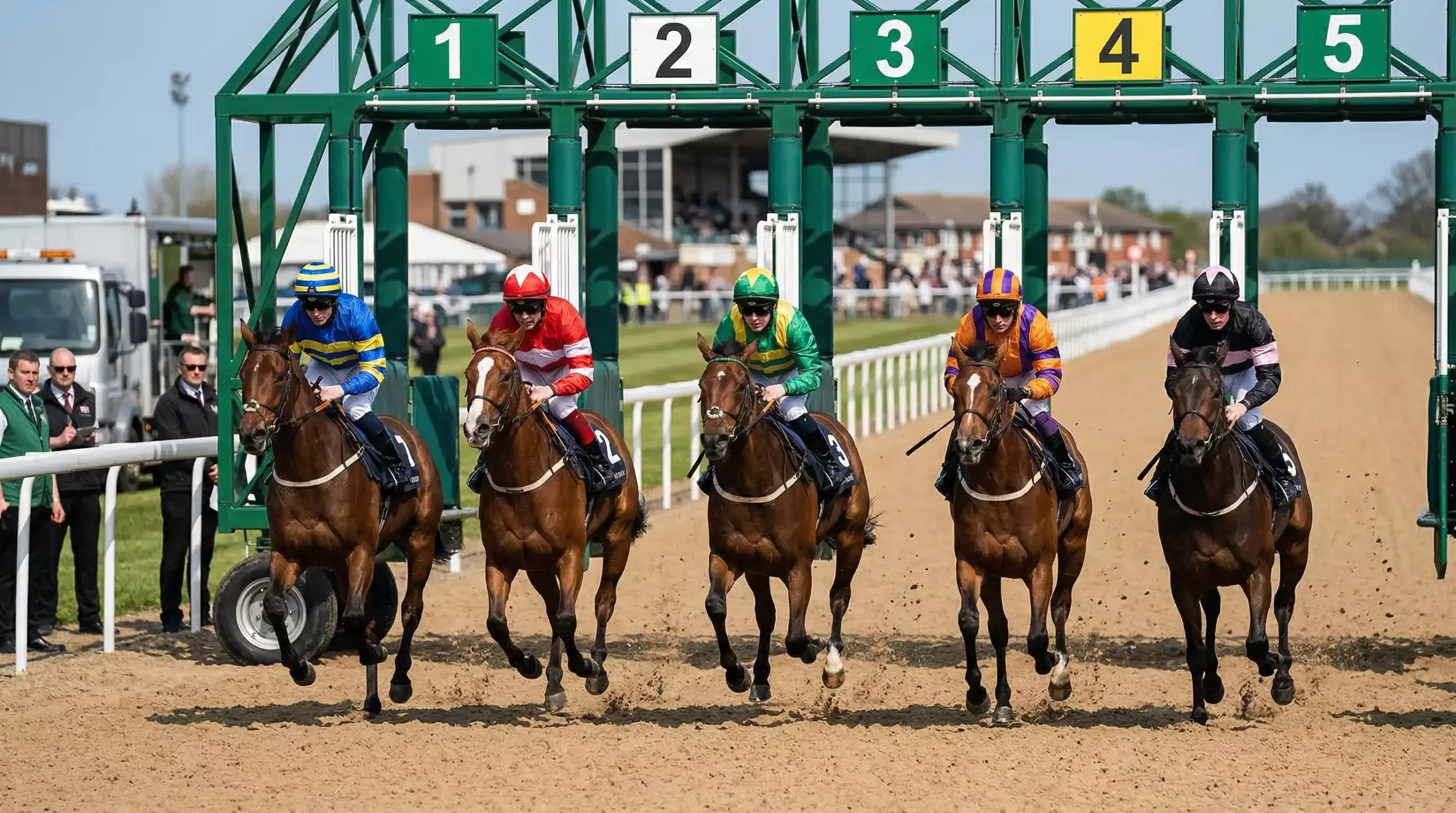
- What Draw Bias Means and Why It Varies by Course
- Chester — Where High Draws Lose Runners
- Beverley — The Opposite Pattern
- Stall Shuffling and Defragging After Withdrawals
- How Losing a Pace Setter or a Closer Reshapes the Race
- A Step-by-Step Workflow for Re-Assessing After NR
- Tools and Data Sources for Draw and Pace Analysis
A twelve-runner sprint at Newmarket and a ten-runner sprint at Newmarket are not the same race. Remove two horses from the declared field — even two 33/1 no-hopers — and the geometry of the contest shifts. The stall positions that remain active change relative to the rail. The pace profile reconfigures because the horse who was going to blaze from stall eleven is gone, or the closer who needed traffic to hide behind has lost their cover. The draw, which was already loaded toward one side of the track, now favours different horses than it did when the full field was declared.
A scratch in stall 12 changes stall 1. That’s the principle this article explores. Draw bias in UK Flat racing is well documented in raw form — every serious form student knows that Chester favours low draws and Beverley often favours high ones. What’s far less discussed is how non-runners distort those biases in real time, how the stall-shuffling process works after withdrawals, and how the loss of a specific running style reshapes the pace dynamics that the draw advantage depends on.
This isn’t abstract theory. There are concrete data points from specific courses, a mechanical process called defragging that moves horses into different stalls after withdrawals, and a workflow you can apply to any race where a non-runner has been declared. The numbers do most of the talking here. The interpretation is yours.
What Draw Bias Means and Why It Varies by Course
Draw bias is the statistical tendency for horses drawn on one side of the stalls to outperform horses drawn on the other, all else being equal. It exists because racecourses are not symmetrical environments. The camber of the track, the positioning of the first bend relative to the start, the width of the racing surface, the location of the rail — all of these physical features create asymmetries that give one group of stalls an inherent advantage over another.
On a tight, turning course like Chester, the inside rail is the shortest route around every bend. A horse drawn in stall one starts closest to that rail and can hold the position through the first turn without expending extra energy. A horse drawn in stall fourteen has to cover more ground just to reach the same point on the track. Over five furlongs, that difference can amount to several lengths — not because one horse is slower, but because the track geometry penalises wide draws.
On a straight course — the July Course at Newmarket, for instance — there are no bends to favour, but the going can vary across the width of the track. If the far side has firmer ground because it’s been used less, horses drawn high will travel on a faster surface. If recent rain has made the stands’ side heavier, low draws are at a disadvantage that has nothing to do with the stall number itself and everything to do with where the ground is riding best.
The critical point is that draw bias is not fixed. It shifts with field size, going conditions, race distance, and the pace of the race. A course that shows a strong low-draw bias in twelve-runner sprints might show no bias at all in six-runner mile races, because the dynamics of the start and the first bend are completely different. And when horses are withdrawn after declarations — when the field drops from twelve to ten, or from ten to eight — the draw bias that applied to the original field may no longer describe the race that’s actually being run.
This is the point most form guides miss. They publish draw statistics based on the declared field, not the actual field after non-runners. A 20% win rate for stalls 1–4 in twelve-runner races at Chester is useful data — but if two horses are scratched from stalls 10 and 12, and the remaining field is reshuffled, you’re no longer looking at a twelve-runner race. You’re looking at a ten-runner race with a different stall configuration, and the historical bias needs to be re-assessed against that new reality.
Chester — Where High Draws Lose Runners
Chester is the most draw-biased major racecourse in Britain, and it isn’t close. The track is an almost-circular loop — the tightest in the country — where the first bend arrives within seconds of the stalls opening. Horses drawn wide have to use energy crossing over to the inside, and in big fields they may never get there. The data reflects this brutally.
According to analysis by FlatStats, 61.7% of all Flat winners at Chester since 2010 were drawn in stalls one through four. In a perfectly unbiased world, you’d expect that figure to sit around 30–35% in an average field. Chester roughly doubles it. The inside stalls aren’t just an advantage; they’re close to a prerequisite in sprint races.
Now look at the non-runner pattern. Of all horses declared as non-runners at Chester, 54.6% were drawn in high stalls — the very positions where the draw disadvantage is most severe. Only 18.2% of non-runners were drawn in low stalls. That asymmetry is too stark to be coincidental. Trainers and connections know the draw data. A horse drawn in stall thirteen at Chester has a dramatically lower chance of winning than the same horse drawn in stall two. When that horse also faces unsuitable going, a minor fitness doubt, or a better engagement later in the week, the draw becomes the tipping point. The trainer pulls the horse — not because it can’t win, but because the expected value of running from that stall is too low to justify the effort.
This creates a feedback loop. High-drawn horses are withdrawn more often, which reshuffles the remaining field and compresses the stall range. A fourteen-runner race that loses three high-drawn horses becomes an eleven-runner race where the surviving highest stall is now closer to the rail than it was in the original declaration. The draw bias hasn’t disappeared — it still favours inside positions — but the threshold at which a draw becomes disadvantageous has shifted inward.
For the bettor, the practical implication is significant. If you see multiple high-draw scratchings at Chester, the remaining high-drawn horses become relatively less disadvantaged than they were in the full field. Stall eight in a fourteen-runner race is a poor draw. Stall eight in an eleven-runner race, after three higher draws have been removed and defragging has occurred, is a meaningfully better position. The raw draw statistics won’t tell you that — they’re calculated on the declared field. The adjusted bias, after non-runners, is what actually matters at the off.
Beverley — The Opposite Pattern
Beverley sits at the other end of the draw spectrum and provides an almost clinical counter-example to Chester. The course configuration rewards high draws in certain conditions — the stands’ side of the track can ride faster, and the camber works in favour of horses drawn wide who can establish a position without being forced into traffic on the inside.
The non-runner data confirms the mirror image. FlatStats data shows that 54.8% of non-runners at Beverley were drawn in low stalls, compared with just 19.1% drawn high. Where Chester loses its outside horses, Beverley loses its inside ones — and for the same underlying reason. Trainers recognise the draw disadvantage and use it as a factor in withdrawal decisions.
The significance of the Chester-Beverley comparison goes beyond the individual courses. It demonstrates a structural principle: non-runner patterns are not random. They cluster on the disadvantaged side of the draw, because trainers — consciously or through accumulated habit — withdraw horses that face the steepest disadvantage. This means that any course with a documented draw bias is likely to exhibit a non-runner pattern that correlates with that bias. Low-draw courses lose high-drawn runners disproportionately. High-draw courses lose low-drawn runners.
For the form student, this is actionable intelligence. When non-runners are announced for a race at a biased course, check which stalls have been vacated. If the withdrawals are concentrated on the disadvantaged side — which the data says they will be, more often than not — the remaining field is more competitive than the declared field was. The horses that stayed in are the ones whose connections believed the draw gave them a viable chance. That self-selection effect narrows the likely outcome range and can shift the value in the market.
Stall Shuffling and Defragging After Withdrawals
When a horse is declared a non-runner, its stall doesn’t simply sit empty. The remaining horses are reorganised through a process commonly called defragging — borrowing the term from computer science, where fragmented data is consolidated into contiguous blocks. The racing version works the same way: gaps left by withdrawn horses are closed up, and the surviving runners are moved into a tighter, sequential range of stalls.
The specifics of how defragging works vary by racecourse and by the starter’s discretion, but the general principle is consistent. If stall seven is vacated, horses in stalls eight and above shift down by one. If stalls three and nine are both vacated, the adjustment cascades: stall four becomes stall three, stall five becomes stall four, and so on. By the time the field loads, the stalls in use are a contiguous block starting from stall one — no gaps, no empty metal frames swinging open on one side of the line.
This matters enormously for draw analysis, and FlatStats has documented the issue in detail. The horse you backed because it was drawn in stall five — a favourable position at, say, Haydock — might now be loading from stall three after defragging. The draw bias data you used to assess that position was based on historical results from stall five in full fields. Stall three in a reduced field is a different proposition, because the horse is now closer to the rail, with fewer runners inside it and a different set of rivals alongside.
The error most punters make is treating the original draw number as permanent. It isn’t. Once a non-runner is declared and defragging occurs, the original stall allocation is irrelevant — what matters is the actual loading position at the start. Some data services publish adjusted draw positions after non-runners; most don’t. If your analysis relies on stall numbers, you need to manually adjust for any withdrawals that shift the line-up.
There’s a secondary effect worth noting. Defragging doesn’t just change positions — it changes proximity. Two horses that were separated by three stalls in the original draw might end up adjacent after a withdrawal reshuffles the order. If both are prominent racers who like to lead, they’re now drawn next to each other and more likely to engage in an early speed duel. That wasn’t the case in the declared field, and it wouldn’t show up in any standard form analysis that doesn’t account for post-NR stall moves.
How Losing a Pace Setter or a Closer Reshapes the Race
Draw bias gets most of the attention when a non-runner is announced, but the pace impact can be just as significant — and it’s harder to quantify because it depends on the running styles of specific horses rather than the geometry of the track.
Every race has a pace profile: the expected speed at which the field will travel through the early, middle, and late stages. That profile is shaped by the horses who are entered. A race with three confirmed front-runners will be run differently from one with a single pace-maker and a pack of hold-up horses. When a non-runner is declared, you need to know what role that horse was likely to play in the pace scenario — because removing a front-runner and removing a closer produce opposite effects on the rest of the field.
Lose a front-runner and the early pace drops. The remaining leaders have less pressure to go fast, the race is more likely to be run at a crawl, and it becomes a sprint from the two-pole. Hold-up horses who rely on a strong pace to set up their finishing kick are suddenly at a disadvantage — their running style depends on the leaders going hard enough to set up gaps in the final furlong. Without that pace, the race turns tactical, and the horse with the best cruising speed or the most adaptable jockey tends to win.
Lose a closer and the front-runners breathe easier. There’s less pressure behind them, less chance of being swallowed up in the final furlong, and a greater likelihood that the race will be won from the front. For punters who assess pace as part of their form study, a withdrawn closer is a cue to look more favourably at prominent racers — horses who like to bowl along in the first two or three and sustain their effort to the line.
Richard Wayman’s observation that non-runners reduce “the competitiveness of races” applies here in a precise, mechanical sense. It isn’t just that the field is smaller. It’s that the tactical balance of the race has changed. A twelve-runner handicap with a confirmed strong pace plays to certain types of horse. The same race without the pace-maker plays to different types entirely. The non-runner doesn’t just remove one competitor — it reshapes the contest for everyone who remains.
The interaction between draw and pace is where this gets genuinely complex. At Chester, a front-runner drawn low is the ideal combination — inside rail, early lead, tight turns that make it hard to pass. Remove that horse and the race loses both its pace-setter and its draw-bias beneficiary. The remaining low-drawn horses might not have the speed to lead, and the remaining front-runners might be drawn too wide to get across. The entire dynamic flips. That’s why treating draw and pace as separate analyses is a mistake — they’re interconnected, and a single non-runner can unravel both.
A Step-by-Step Workflow for Re-Assessing After NR
When a non-runner appears on tomorrow’s card, the instinct is to shrug and move on — one less horse, slightly shorter odds, nothing to worry about. That instinct costs money over time. Here’s a structured approach to re-assessing a race after a withdrawal, built around the draw and pace principles covered above.
Start with the stall. Identify which stall has been vacated and check whether defragging will shift the remaining positions. If the course publishes adjusted draws, use them. If not, count down manually — every horse drawn above the vacant stall moves one position closer to the inside. Note the new stall numbers alongside the original ones, and assess the draw bias data for the adjusted field size, not the declared one. Premier Flat fixtures in late 2025 averaged 10.97 runners per race according to BHA data — that’s the baseline you’re working with, and any withdrawal takes you below it into territory where draw effects often compress.
Next, identify the running style of the withdrawn horse. Was it a likely front-runner, a mid-pack tracker, or a hold-up closer? If you don’t know, check its recent race replays or sectional timing data. A withdrawn front-runner is the most impactful pace change in most fields, because it directly affects the early speed of the race. A withdrawn closer is less dramatic but still relevant — it reduces pressure on the leaders.
Then re-map the pace scenario. With the non-runner removed, how many confirmed front-runners remain? If the race still has two or three pace-pressers, the dynamics probably haven’t changed much. If it’s dropped to one, you’re looking at a potential soft lead and a tactical race that favours different horses. Re-rank your selections based on the new pace profile rather than the one you built from the declared field.
Finally, check the market. Non-runners should be reflected in the prices, but the speed of market adjustment varies. If you’ve identified a pace-shift that favours a particular horse and the market hasn’t moved to reflect it, there’s potential value. Conversely, if the market has already compressed around the obvious beneficiary of the withdrawal, the value may have gone — the crowd has done the same analysis you have, just faster.
This entire process takes ten minutes. It won’t apply to every non-runner — a 50/1 outsider pulled from a twenty-runner handicap changes almost nothing. But when a well-drawn front-runner or a key closer is scratched from a race you’ve already studied, the ten minutes are worth the effort.
Tools and Data Sources for Draw and Pace Analysis
FlatStats is the primary free resource for draw bias data that accounts for non-runners. Their adjusted draw bias analysis recalculates stall performance based on the actual field that raced rather than the declared field, which makes their numbers significantly more useful than raw draw tables that treat every declared runner as a starter. The site also provides course-by-course breakdowns that let you assess bias at specific distances and field sizes.
For pace analysis, Timeform’s sectional timing data remains the industry standard. Sectionals show how fast each horse travels through different stages of a race, which lets you classify running styles with data rather than guesswork. A horse that consistently clocks fast early sectionals and slower late ones is a front-runner; one that does the opposite is a closer. When a non-runner is declared, those sectional profiles are what you use to assess whether the pace dynamic has changed.
Racing Post and At The Races both publish non-runner updates throughout the morning, and both show adjusted draw positions when available. The BHA’s own data feeds, accessible through Racing Admin, provide the official non-runner declarations as they’re filed. For live stall-loading information on race day, racecourse social media accounts and SIS broadcast feeds are often the quickest sources.
If you build models, the key is to integrate draw bias and pace data into a single framework rather than treating them as separate inputs. A model that adjusts draw bias for non-runners but ignores the pace impact of those same withdrawals is only doing half the work. The courses where this matters most — Chester, Beverley, Epsom, Goodwood, any track with a pronounced turning bias — are also the courses where trainers are most likely to use the draw as a factor in withdrawal decisions. The data exists to quantify these effects. The edge goes to the punter who uses it.